
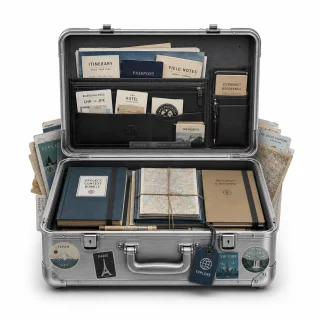
A metal travel case covered in destination stickers — a metaphor for portable, packed knowledge

Open Context Format

Pack knowledge.
Make it portable.

.context is an open file format for capturing organisational, project, or domain-specific knowledge in a portable, machine-readable form — ready to load into AI assistants, knowledge tools, or your own applications.
Version 0.1 — Working Draft · Licence: CC BY 4.0

One file, all the context

Teams build up deep, hard-won knowledge about their organisations, processes, and decisions. That knowledge lives in notes, transcripts, and the heads of the people who were in the room. .context is a standard for bundling it — so it travels, ages well, and can be reasoned over by AI tools that didn't attend the meetings.

A .context file is a ZIP archive with a defined internal structure. It bundles structured knowledge — interview notes, process documentation, stakeholder profiles, decisions, learnings — into a single artefact. Any tool that implements the spec can open it.

📦

Portable

Readable by any tool that implements the spec. Not tied to a vendor, model, or platform.

🔍

Auditable

Every claim traceable to its source. Provenance metadata is a first-class citizen of the format.

📋

Versionable

Diffable, revisable, and historically navigable. Just a ZIP — works with any version control system.

🤖

Agent-ready

Self-describing for AI consumers. The AGENTS.md file tells an AI agent exactly how to reason with the contents.

A ZIP with a shape

A .context file is a standard ZIP archive. Rename any .context file to .zip and open it with any archive tool. The structure inside is what the spec defines.

Open metal case packed with documents
acme-project.context/
├── manifest.json required Format version, metadata, integrity
├── README.md required Human-readable overview
├── AGENTS.md required Orientation document for AI agents
├── 00_meta/ optional Format-level metadata, schemas
├── 01_context/ required Background, environment, constraints
├── 02_stakeholders/ optional People, roles, relationships
├── 03_processes/ optional How things work today
├── 04_artefacts/ optional Documents, decisions, outputs
├── 05_learnings/ optional What's been tried, what worked
└── 06_open_questions/ optional Known gaps, ambiguities

Folder numbering is conventional, not enforced — readers must not rely on order. The folder names (after the numeric prefix) are part of the spec and must be used as shown.

Three files make a valid context

A valid .context file must contain exactly three files at its root. These three together give you machine-readable identity, human orientation, and AI orientation.

manifest.json Machine-readable

The only mandatory machine-readable file. Identifies the context, declares its format version, and carries metadata. A reader uses this to determine whether it can open the file and how to present it.

// Minimum viable manifest.json
{
  "context_format_version": "0.1",
  "id": "acme-project-2026",
  "title": "Acme — Project Alpha Context",
  "created": "2026-05-01T10:00:00Z",
  "updated": "2026-05-01T10:00:00Z",
  "version": "1.0.0",
  "authors": [
    { "name": "Your Team" }
  ],
  "licence": "proprietary",
  "summary": "One sentence. What this context is."
}

Optional fields: tags, domain, language, successor_of, dependencies, provenance_policy.

README.md Human-readable

A human-readable overview for someone browsing the file in a file manager, IDE, or text editor. It should answer four questions:

  • What is this?
  • Who is it for?
  • How is it organised?
  • Who maintains it, and what's the licence?
AGENTS.md Agent-readable

An orientation document for AI agents — and for humans reasoning with the context rather than about it. This is what makes .context more than a generic ZIP of documents: it is self-describing for AI consumers.

An agent loading a .context file should read AGENTS.md first and use it to calibrate every subsequent retrieval and response.

It should include:

  • What this is — scope and purpose, one paragraph
  • How to use it — which documents to trust, when to verify against sources
  • State of things — current phase, last update, known gaps
  • Key principles — reasoning constraints and epistemic rules
  • Pointers — recommended entry points for common queries
  • Out of scope — what this context does NOT contain

Every claim traceable

Knowledge without provenance is noise. Every document in a .context file should declare where its claims came from, who said them, and how confident the author was.

Inline citation

Claims include source attribution in the document body.

According to Maya (2026-04-15
interview), the approval process
takes 6–8 weeks in most regions…

Document-level frontmatter

A YAML block at the top of the file declares sources, date, and confidence.

---
sources:
  - type: interview
    person: Maya
    date: 2026-04-15
confidence: high
last_verified: 2026-05-01
---

Documents without provenance are valid but should be flagged by readers. A well-formed .context file tells an AI agent not just what the answer is, but how confident to be in it.

What goes inside

All content follows a small set of conventions that make .context files consistent and interoperable across tools.

Turn fragments into context, and context into better decisions

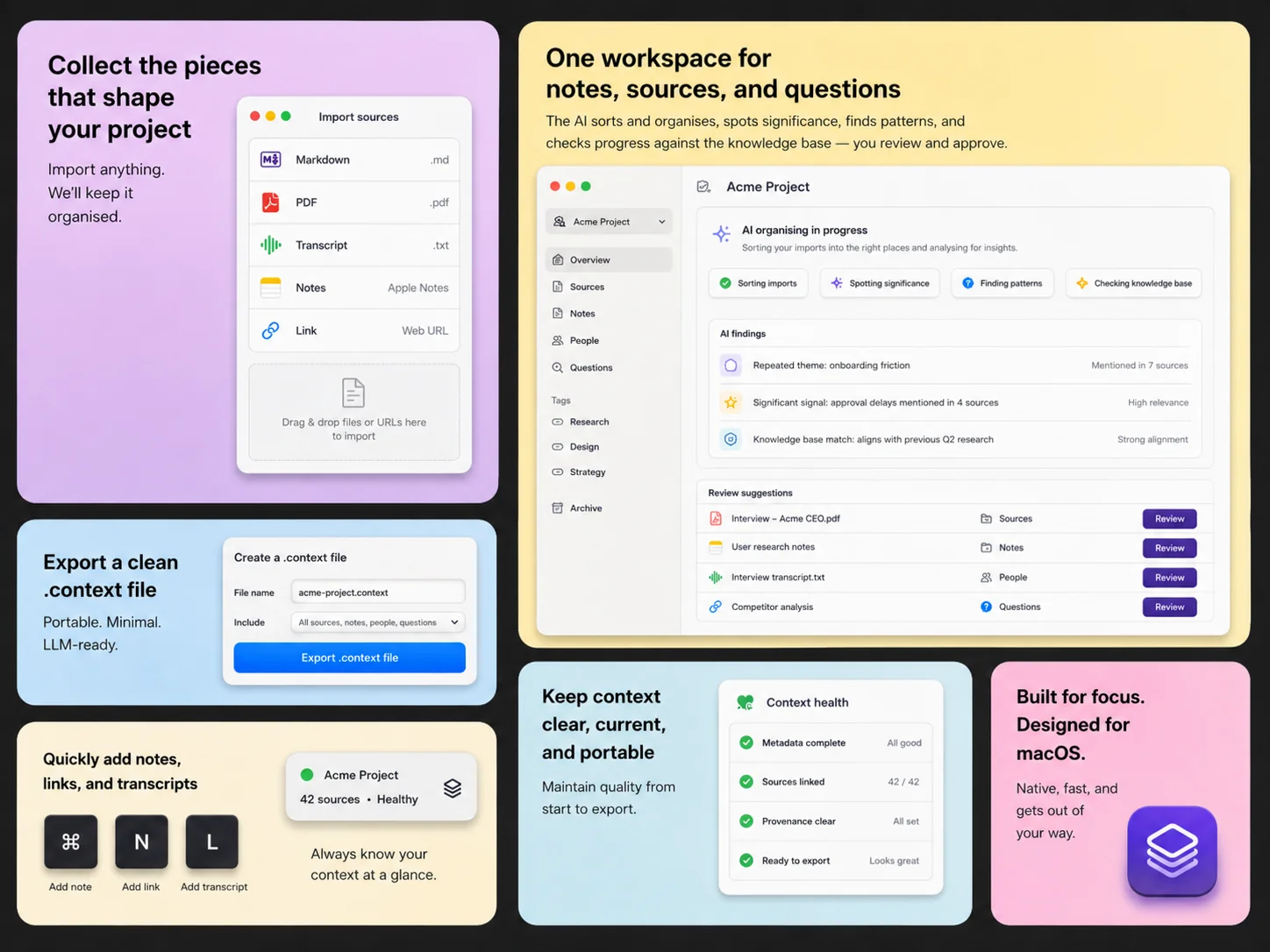
A native macOS application for collecting research fragments from anywhere, letting AI find what matters, and exporting clean .context files ready for any AI tool.

Context app — collect sources, AI organises and surfaces insights, export a clean .context file

Import Markdown, PDFs, transcripts, Apple Notes, and web links. The AI sorts and organises every import, spots significance, finds patterns, and checks progress against your knowledge base — you review and approve. When you're ready, export a portable, LLM-ready .context file in one click.

Collect anything

Drag in files or paste URLs. Supports Markdown, PDF, plain text, Apple Notes, and web links.

AI-powered organisation

The AI sorts imports, spots significance, finds repeated themes, and matches against your existing knowledge base.

One workspace

Sources, notes, people, and open questions — all in one place, with tags to navigate across projects.

Quick capture

Keyboard shortcuts for adding notes, links, and transcripts without breaking your flow.

Context health

Live indicators for metadata completeness, source linkage, provenance clarity, and export readiness.

Export .context

One click produces a portable, minimal, LLM-ready .context file from your workspace.

Where things stand

Version 0.1 — Working Draft

The spec is stable enough to build against. The reference implementation (Context Reader v1) validates the format in production use. The format is in active use; the spec may receive backward-compatible clarifications before a 1.0 release.

Draft
  • Should the format support deltas or patches between versions?
  • How should sensitive sections (PII, commercial confidentiality) be marked and optionally encrypted?
  • Should there be a standard schema for stakeholder profiles, or is that left to convention?
  • What is the relationship between multiple .context files — composition, inheritance, cross-references?
  • Should AGENTS.md have a structured schema, or remain free-form prose?